

As an Amazon Associate we earn from qualifying purchases. Our picks are based on independent research; see our Affiliate Disclaimer.
Choosing the best pickleball paddle is the single biggest equipment decision you will make in this sport. The paddle controls how much power you generate, how easily you can drop the ball into the kitchen and how much spin you can put on serves and rolls. With hundreds of models on the market, the choice can feel overwhelming.
We compared current paddles from JOOLA, Selkirk, Vatic Pro, Franklin and other trusted brands, focusing on face material, core thickness, shape, weight and grip. Below you will find our top picks for beginners, improving players and advanced competitors, plus a buying guide that explains which specifications actually matter.
Quick Answer: The Best Pickleball Paddle
- Best Overall: JOOLA Pro V Perseus
- Best for Beginners: Selkirk SLK Helix Max
- Best Value Carbon Paddle: Vatic Pro Prism 16mm
- Best for Spin: JOOLA Ben Johns Hyperion CFS 16
- Best for Control: Selkirk LUXX Control Invikta
- Best for Power: Franklin Sports C45 Carbon Fiber Paddle
- Best Budget Set: Selkirk SLK Neo 2.0 Paddle Set
If you want one paddle that can grow with you, the JOOLA Pro V Perseus is our pick for the best pickleball paddle overall thanks to its powerful yet controllable frame. Beginners will be happier with the forgiving Selkirk SLK Helix Max, and value seekers should start with the Vatic Pro Prism.
Best Pickleball Paddle Comparison Table
Use this table to compare our picks at a glance, then jump to the full review of any paddle.
| Product | Best For | Type | Key Feature | Buy |
|---|---|---|---|---|
| JOOLA Pro V Perseus | Best Overall | Carbon | KineticFrame + TechFlex | Check Price ↗ |
| Selkirk SLK Helix Max | Best for Beginners | Hybrid carbon | Carbon + fiberglass face | Check Price ↗ |
| Vatic Pro Prism 16mm | Best Value Carbon Paddle | Raw carbon | T700 raw carbon, foam walls | Check Price ↗ |
| JOOLA Ben Johns Hyperion CFS 16 | Best for Spin | Carbon | Carbon Friction Surface | Check Price ↗ |
| Selkirk LUXX Control Invikta | Best for Control | Raw carbon | 19 mm X7 core | Check Price ↗ |
| Franklin Sports C45 Carbon Fiber Paddle | Best for Power | Thermoformed carbon | Double thermoformed | Check Price ↗ |
| Selkirk SLK Neo 2.0 Paddle Set | Best Budget Set | Graphite set | Graphite face, 7.5 oz | Check Price ↗ |
The 7 Best Pickleball Paddles of 2026
Every paddle below is a real, currently available model. Our picks for the best pickleball paddle are ordered by how well each one serves the widest range of players, starting with the most complete performer.

1. The JOOLA Pro V Perseus is the most complete paddle on our list. Its KineticFrame construction adds power on drives without making soft shots jumpy, and the textured raw carbon face produces heavy spin.
👍 Pros & Cons
Pros
- Newest JOOLA frame technology
- Explosive drives with controlled resets
- Durable high-friction face
- NFC registration for warranty
Cons
- Premium price
- Elongated shape rewards experienced players
📄 Detailed Review
- Face: reinforced textured raw carbon fiber
- Frame: KineticFrame technology
- Tech: TechFlex Power
- Size: 16.5″ x 7.5″, 8.1 oz average
- Handle: 5.5″ length, 4.25″ circumference
- NFC chip; USAP and UPA-A certified
The Pro V is JOOLA’s newest flagship. Its KineticFrame construction is inspired by how a hockey stick flexes to store and release energy, adapting to your swing for powerful drives while staying controlled on soft shots.
The elongated Perseus shape measures 16.5 x 7.5 inches with an 8.1-ounce average weight and 5.5-inch handle. An embedded NFC chip connects to the JOOLA Connect app for registration and a 12-month warranty.

2. The Selkirk SLK Helix Max blends a carbon and fiberglass face with a wide Max shape, so new players get a big sweet spot and reliable control while still having enough power to finish points.
👍 Pros & Cons
Pros
- Hybrid face blends control and power
- Max shape gives a large sweet spot
- Thermoformed for shot consistency
- Designed for players new to competitive play
Cons
- Not as spin-heavy as full raw carbon
- Fewer customization options
📄 Detailed Review
- Face: carbon + fiberglass hybrid
- Core: thermoformed carbon fiber construction
- Shape: Max (all-around)
- Weight: about 8 oz
- Grip: 4.25″
The SLK Helix Max is a true all-around design. Selkirk combines a carbon and fiberglass hybrid face with thermoformed carbon construction, aiming for control without giving up power.
The Max shape is wide and forgiving, which keeps more shots on the sweet spot during fast exchanges. Selkirk positions it for players who are new to the game but want performance that will keep up as they improve.

3. Vatic Pro’s Prism brings raw T700 carbon and foam-injected walls to a mid-tier price. Its cold-molded build favors touch, making it ideal for dink-heavy players.
👍 Pros & Cons
Pros
- Raw T700 carbon at a mid-tier price
- Foam walls stabilize off-center hits
- Cold-molded build favors touch and resets
- Paddle cover included
Cons
- Less raw power than thermoformed paddles
- Long 5.3″ handle listing may not suit every grip
📄 Detailed Review
- Face: raw T700 carbon fiber
- Core: 16 mm polypropylene with foam-injected edge walls
- Build: cold-molded for control
- Weight: about 8 oz
- Size: 16.3″ x 7.7″
- Includes paddle cover; USA Pickleball approved
The Prism series is Vatic Pro’s answer to the question “can a carbon fiber paddle be affordable?” It uses a raw T700 carbon face for grit and spin, a 16 mm core and foam-injected edge walls that increase stability on mishits.
Vatic Pro cold-molds the Prism instead of thermoforming it, which the brand says adds control and touch at the cost of some raw power. That makes it a strong match for players who win points with dinks, drops and resets.

4. The JOOLA Hyperion CFS uses a durable Carbon Friction Surface and Hyperfoam edge walls, giving advanced players dependable spin and edge-to-edge stability.
👍 Pros & Cons
Pros
- Durable textured face built for spin
- Hyperfoam walls enlarge the sweet spot
- Stable, consistent feel
- Signature paddle of a top pro
Cons
- Heavier swing weight
- Elongated shape is less forgiving for beginners
📄 Detailed Review
- Face: Carbon Friction Surface (Carbon-Flex5)
- Edges: Hyperfoam edge wall
- Core: Reactive polypropylene honeycomb, 16 mm
- Handle: carbon-forged, 5.5″ length
- Weight: about 8.4 oz
- USA Pickleball approved
The Hyperion CFS upgrades the original Hyperion with JOOLA’s Carbon-Flex5 Carbon Friction Surface, designed to be more durable and longer-lasting while maximizing spin.
Specialized Hyperfoam injected into the perimeter adds weight and stability, increasing the sweet spot. The carbon-forged handle and reactive 16 mm core are tuned for advanced players who want consistency.

5. With an extra-thick 19 mm core, the Selkirk LUXX Control absorbs pace for soft drops and resets, while the InfiniGrit surface keeps spin consistent over time.
👍 Pros & Cons
Pros
- Extra-thick 19 mm core for control
- InfiniGrit surface for durable spin
- EVA handle reduces vibration
- Premium Selkirk construction
Cons
- Less pop than thinner power cores
- Premium price tier
📄 Detailed Review
- Face: Florek carbon fiber with InfiniGrit surface
- Core: X7 ThikSet honeycomb, 19 mm
- Handle: EVA foam-injected handle and throat
- Shape: Invikta (elongated)
The LUXX Control is Selkirk’s premium control paddle. Its 19 mm X7 ThikSet honeycomb core is thicker than most paddles, which slows the ball down for soft drops and resets.
Selkirk’s InfiniGrit surface is designed to triple raw carbon durability, and the proprietary Florek carbon fiber enlarges the sweet spot. EVA foam in the handle and throat smooths out vibration.

6. Franklin’s double-thermoformed C45 adds pop from a foam layer inside its 16 mm core and keeps its 45-degree carbon texture consistent across the face.
👍 Pros & Cons
Pros
- Double thermoforming for durability
- 45° texture for consistent spin
- Foam layer adds pop on drives
- USA Pickleball and UPA approved
Cons
- Heavier listing than average
- Power-leaning feel needs control at the kitchen
📄 Detailed Review
- Face: T700 carbon fiber peel-ply texture at 45°
- Core: PowerFlex 16 mm polymer with inner foam layer
- Build: double thermoformed
- Size: 16.4″ x 7.6″
- Handle: 5.6″ length, 4.3″ circumference
- Approved by USA Pickleball and UPA
Franklin built the C45 for competitive players. The paddle is thermoformed twice to strengthen its structure, and the T700 carbon peel-ply texture is laid at a 45-degree angle to keep grit consistent across the face.
Inside, a 16 mm PowerFlex polymer core includes an inner foam layer for extra pop. The 16.4 x 7.6-inch shape and 5.6-inch handle give a blend of reach and sweet spot that works from the baseline to the kitchen.

7. If you are buying for two people, the Selkirk SLK Neo 2.0 set includes two light graphite paddles, balls and a sling bag from a brand known for quality.
👍 Pros & Cons
Pros
- Brand-name build quality from Selkirk
- Graphite face adds control and touch
- Light 7.5 oz paddles are quick at the net
- Includes balls and a sling bag
Cons
- 13 mm core gives less pop than thicker power paddles
- Graphite face has less grit than raw carbon
📄 Detailed Review
- Face: G4 Control Graphite with SpinFlex texture
- Core: SX4 polymer honeycomb, 13 mm
- Weight: 7.5 oz
- Grip: 4.25″ circumference, 5.25″ length
- Includes 2 paddles, pickleballs and a sling bag
The SLK Neo 2.0 bundle is Selkirk’s entry-level set, and it carries the brand’s design approach into an affordable package. The G4 Control Graphite surface with SpinFlex texture favors placement and touch, while the 13 mm SX4 honeycomb core softens impact for a consistent feel.
At 7.5 ounces each, the paddles sit between lightweight and midweight, so they are quick in hand battles yet stable enough for drives. The Ultra-Comfort grip measures 4.25 inches around and 5.25 inches long.
How We Chose the Best Pickleball Paddle
To choose the best pickleball paddle for this guide, we started with paddles that are approved for sanctioned play, then compared manufacturer specifications for face material, core thickness, weight, shape, handle length and construction method (thermoformed, cold-molded or traditional). We also reviewed recurring themes in verified owner feedback, such as durability of the textured face, edge separation and grip comfort.
Approval matters because textured faces and paddle dimensions are regulated. The USA Pickleball Equipment Standards Manual explains the size, surface roughness and deflection rules that tournament paddles must meet. You can read our full research process on the How We Test page.
Buying Guide: How to Choose the Best Pickleball Paddle
Specifications on paddle listings can be confusing. These are the factors that change how a paddle actually plays.
Face Material: Fiberglass, Graphite or Raw Carbon
Fiberglass faces are flexible and add easy pop, which helps beginners hit deep. Graphite faces are stiffer and lighter, giving a crisp, controlled feel. Raw carbon fiber, especially T700 carbon, has a rough texture that grips the ball for more spin and tends to hold its texture longer.
If you are just starting out, fiberglass or a hybrid face is forgiving. Once you begin hitting third-shot drops and topspin drives, raw carbon is worth the upgrade.
Core Thickness: 11 mm to 19 mm
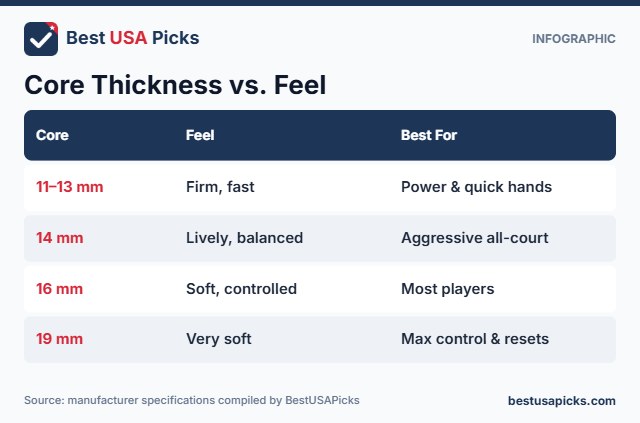
Thinner cores (11–14 mm) feel firmer and send the ball off the face faster, which adds power. Thicker cores (16 mm and above) absorb more energy, producing a softer, more controlled feel and a larger effective sweet spot.
Most players are well served by a 16 mm core. Choose 13–14 mm if you want quicker hands and more pop, or 19 mm if your game is built on resets and dinks.
Paddle Weight
Lightweight paddles (under about 7.8 oz) are quick at the net but transmit more vibration. Midweight paddles (about 7.8–8.4 oz) balance power and stability and suit most adults. Heavier paddles add plow-through on drives but can tire the arm.
If you have a history of elbow or shoulder discomfort, avoid very light paddles with thin cores, which can feel harsh on off-center hits.
Shape and Sweet Spot
Standard and wide-body paddles (around 16 x 7.8–8 inches) maximize the sweet spot. Elongated paddles (around 16.5 x 7.5 inches) add reach and swing speed for power and two-handed backhands, but the sweet spot is narrower.
Hybrid shapes sit in between and are a safe choice when you are unsure.
Grip Size and Handle Length
Most adults use a grip circumference between 4 and 4.5 inches. A grip that is too thick limits wrist snap, while one that is too thin makes you squeeze harder. If you are between sizes, choose the smaller grip and add an overgrip.
Handles of 5.5 inches or longer make room for a two-handed backhand.
Tournament Approval and Warranty
If you plan to play in sanctioned events, confirm the paddle is approved by USA Pickleball (and UPA-A if you play those events). Also check the warranty, since textured carbon faces and edges can wear with heavy use.
Tips to Make Your Pickleball Paddle Last
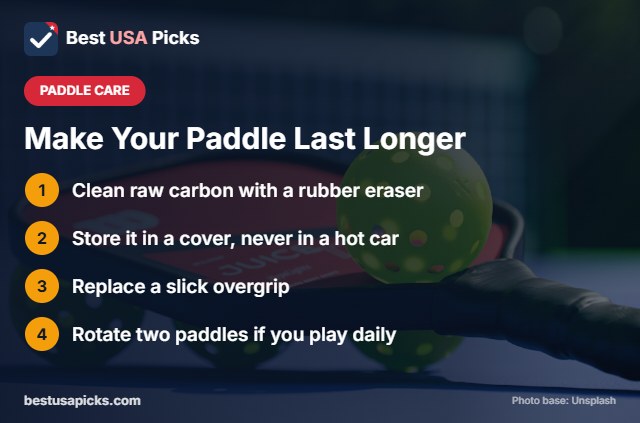
- Clean raw carbon faces with a dedicated rubber eraser or damp microfiber cloth to restore grip.
- Store your paddle in a cover and avoid leaving it in a hot car, which can weaken adhesives.
- Replace the overgrip when it becomes slick; a fresh grip improves control and reduces squeezing.
- Rotate between two paddles if you play daily so one is always ready if the face wears.
Still deciding on the best pickleball paddle for your game? These answers cover the questions we hear most.
Frequently Asked Questions
What is the best pickleball paddle for most players?
For most players, the best pickleball paddle is a midweight, 16 mm paddle with a textured carbon or hybrid face and a standard or hybrid shape. In our list, the JOOLA Pro V Perseus is the top all-around performer, while the Selkirk SLK Helix Max is easier to learn with.
Is carbon fiber better than fiberglass?
Carbon fiber generally offers more spin, control and durability, while fiberglass offers more pop and a softer price. Beginners can play well with fiberglass, but most intermediate players benefit from carbon.
How often should I replace my pickleball paddle?
Recreational players often use a paddle for one to two years. Replace it sooner if the face loses texture, you hear rattling, the edge guard separates or the paddle suddenly feels dead.
Does paddle weight really matter?
Yes. Weight affects swing speed, stability and comfort. Midweight paddles of roughly 7.8 to 8.4 ounces suit the widest range of players.
Do I need a USA Pickleball approved paddle?
Only if you play sanctioned tournaments. For recreational play any paddle works, but approved paddles meet published standards for size and surface texture.
Final Verdict
Our final pick for the best pickleball paddle is the JOOLA Pro V Perseus, which combines power, spin and control better than any other paddle we compared. If you are new to the game, start with the Selkirk SLK Helix Max, and if you want carbon performance at a friendlier price, choose the Vatic Pro Prism 16mm.
Related Guides
Keep researching with these related pickleball guides from our team:
- Best Pickleball Paddle for 3.0 Player: 7 Forgiving Picks for 2026
- Best Pickleball Paddle for 3.5 Player: 7 Spin & Control Picks 2026
- Best Pickleball Paddle for 4.5 Player: 7 Elite Paddles Ranked 2026
- Best All Around Pickleball Paddle: 7 Balanced Picks for 2026 Play
- Best Mid Range Pickleball Paddle: 7 Carbon Picks Worth It in 2026
Prices and availability change frequently. Product details are based on manufacturer specifications at the time of writing; always confirm the latest information on Amazon before you buy.